


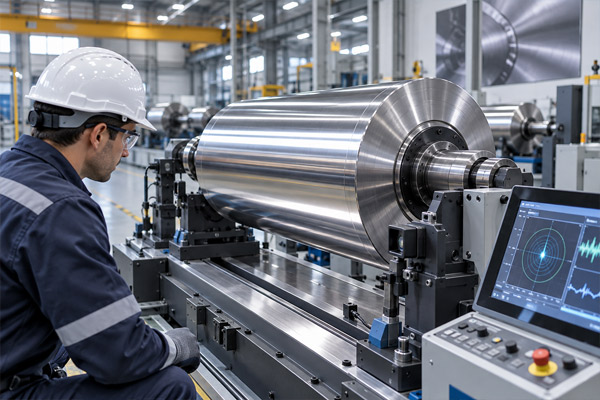
How Roller Balance Affects Speed and Machine Life
Modern industrial machines are expected to operate faster while maintaining accuracy, product quality, and stable production. In such machines, rollers rotate continuously and often work under demanding operating conditions. Even a small imbalance in a roller can create vibration, noise, uneven movement, bearing load, and poor process quality.
This is why precision balancing is important for an SS Cladding Roll, especially when it is used in high-speed industrial machinery.
A properly balanced stainless steel cladding roll rotates smoothly around its axis. It helps maintain stable material movement, protects machine components, improves surface quality, and supports continuous production.
For industries using rollers in textile, paper, packaging, metal processing, lamination, and similar applications, balancing should therefore be considered an important part of roller selection.
What Is Precision Balancing in an SS Cladding Roll
Precision balancing is the process of checking and correcting uneven weight distribution around a roller.
Ideally, the weight of an industrial roller should be evenly distributed around its rotating axis. If one section is slightly heavier than another, centrifugal force increases as the roller rotates.
At low speed, a small imbalance may not be easily noticed. At higher operating speeds, however, the same imbalance can create significant vibration.
Precision balancing helps the roller rotate more uniformly and reduces unwanted forces on the machine.
A well-manufactured stainless steel cladding roll should combine accurate dimensions, proper shaft alignment, suitable surface finishing, and appropriate balancing for its intended operating speed.
Why Balancing Becomes More Important at High Speed
Roller imbalance becomes increasingly important as rotational speed rises.
When an unbalanced roller rotates faster, the heavier portion continuously pulls outward during rotation. This repeated force can create vibration throughout the roller assembly.
The result may include:
- Excessive machine vibration
- Increased bearing load
- Premature bearing wear
- Shaft stress
- Uneven material movement
- Higher operating noise
- Poor surface contact
- Reduced roller life
- Frequent maintenance
- Unexpected production downtime
For this reason, buyers selecting a high-speed SS Cladding Roll should not consider only diameter, length, stainless steel grade, and surface finish. Operating speed and balancing requirements are equally important.
How Precision Balancing Improves Product Quality
In many industrial processes, material remains in direct contact with the roller.
If the roller vibrates while rotating, this contact may not remain uniform. Depending on the application, it can affect material tension, movement, coating, finishing, lamination, or surface quality.
A properly balanced SS Cladding Roll supports stable rotation and more consistent contact between the roller and processed material.
This can help achieve:
- Uniform material movement
- Better tension control
- Consistent surface contact
- Reduced roller marks
- Improved finishing
- Stable process conditions
- Better production consistency
These benefits become especially important in applications where small variations in roller movement can affect the final product.
Precision Balancing Helps Protect Bearings and Shafts
Bearings and shafts support the rotating roller throughout production.
When an SS Cladding Roll is unbalanced, additional forces are transferred to these components during every rotation. Continuous vibration can increase stress on bearings, shafts, couplings, mounting points, and other machine parts.
Over time, this may lead to bearing wear, looseness, alignment problems, or maintenance requirements.
Proper balancing reduces unnecessary rotating forces and helps the roller assembly operate more smoothly.
It can therefore contribute to longer component life and lower maintenance requirements.
Balancing and Surface Finish Work Together
A good SS Cladding Roll requires more than balancing alone.
Surface finish is also important because the roller may directly contact paper, fabric, film, metal sheet, or other processed material.
A roller with excellent balancing but poor surface quality can still create production problems. Similarly, a smooth roller that is not properly balanced may generate vibration at high speed.
For reliable performance, manufacturers should focus on several factors together:
Dimensional accuracy: Diameter, length, shaft size, and related dimensions should match the machine.
Surface finish: The required finish should be selected according to the material and application.
Roller alignment: The shaft and roller body should rotate around the correct centre line.
Balancing: Weight distribution should suit the roller’s operating speed.
Material selection: Stainless steel grade and construction should match the operating environment.
Considering all these factors helps provide more stable industrial performance.
Where High Speed SS Cladding Rolls Are Used
SS Cladding Rolls can be used in different industrial processing systems where strength, surface quality, corrosion resistance, and reliable rotation are required.
Typical application areas may include:
- Textile processing machinery
- Paper processing equipment
- Packaging machinery
- Lamination lines
- Metal processing systems
- Stainless steel processing equipment
- Coating lines
- Material handling systems
- Continuous production machinery
Dhaval Engineering Works includes SS Cladding Rolls within its roller solutions for textile, paper, packaging, metal, and stainless-steel processing industries.
What Buyers Should Share With an SS Cladding Roll Manufacturer
When requesting a custom roller, providing complete technical information helps the manufacturer understand the actual working requirement.
Buyers should ideally provide:
- Required roller diameter
- Face length
- Overall roller length
- Shaft dimensions
- Stainless steel material requirement
- Surface finish requirement
- Maximum operating RPM
- Working temperature
- Material being processed
- Expected load
- Existing machine drawing
- Bearing and mounting details
Operating speed is particularly important because the balancing requirement of a high-speed roller can differ from that of a roller working at relatively low speed.
Choosing an SS Cladding Roll Manufacturer in India
Industrial buyers should choose a manufacturer based on manufacturing capability rather than price alone.
An experienced SS Cladding Roll Manufacturer in India should be able to understand machine drawings, application conditions, dimensions, surface requirements, operating speed, and customization needs.
For businesses looking for an SS Cladding Roll Manufacturer in Ahmedabad or SS Cladding Roll Manufacturer in Gujarat, discussing these technical details before production can help avoid compatibility and performance problems.
Dhaval Engineering Works manufactures industrial rollers in Ahmedabad and states that its metal industry rollers undergo dimensional inspection, balancing, and surface-finish checks.
Conclusion
Precision balancing plays an important role in the performance of a high-speed SS Cladding Roll. As roller speed increases, even a small imbalance can result in vibration, bearing stress, uneven material movement, and reduced process stability.
A correctly manufactured and balanced roller can support smoother rotation, better product quality, longer bearing life, lower maintenance, and reliable industrial production.
For custom industrial requirements, Dhaval Engineering Works provides SS Cladding Roll solutions based on machine dimensions and application needs.
FAQs
Precision balancing helps reduce vibration and uneven rotating forces, particularly in high-speed industrial applications.
Continuous imbalance can increase vibration and bearing loads, which may contribute to faster bearing and shaft wear.
Yes. Balancing becomes increasingly important as rotational speed increases because imbalance forces become more noticeable at higher RPM.
Yes. Custom rollers can be developed according to diameter, length, shaft dimensions, surface finish, operating conditions, and machine requirements.
They can be used in textile, paper, packaging, lamination, metal processing, stainless steel processing, and other continuous industrial machinery.
Provide roller dimensions, operating RPM, shaft details, material requirement, surface finish, load, temperature, application, and preferably the existing machine drawing.
Dhaval Engineering Works, Ahmedabad, Gujarat manufactures SS Cladding Rolls and other customized industrial roller solutions.