

Key Benefits of Aluminum Rollers in High-Speed Printing Machines
High-speed printing machines need rollers that can guide paper, film and other web materials smoothly. A roller may look like a simple machine part, but its weight, surface finish, alignment and balance can directly affect how smoothly the material travels through the machine.
An Aluminum Roller is widely used in printing, packaging, rewinding, unwinding and slitting machinery because aluminum combines low weight with useful strength and corrosion resistance. The Aluminum Association describes aluminum as a lightweight, strong and durable material with a high strength-to-weight ratio.
Dhaval Engineering Works manufactures aluminum rollers in Ahmedabad for applications including printing, rewinding, unwinding, slitting, packaging, wrapping and tracking. Its product range includes hard-anodized, dead-shaft, live-shaft, scroll and idler aluminum rollers.
For high-speed printing, choosing the correct roller can help solve problems such as poor web movement, vibration, unwanted marks, tension variation and frequent maintenance.
Why Are Rollers Important in High-Speed Printing?
In a printing machine, the material may pass over many rollers before the final printed product is produced.
Depending on the machine, rollers can help with:
- Guiding the material
- Supporting smooth web movement
- Maintaining the material path
- Rewinding
- Unwinding
- Slitting
- Tracking
- Moving printed film or paper to the next stage
Dhaval Engineering specifically lists printing, tracking, rewinding, unwinding and slitting among the applications for its aluminum rollers.
When machine speed increases, roller condition becomes even more important. A poorly selected or damaged roller may create more noticeable problems at higher operating speeds.
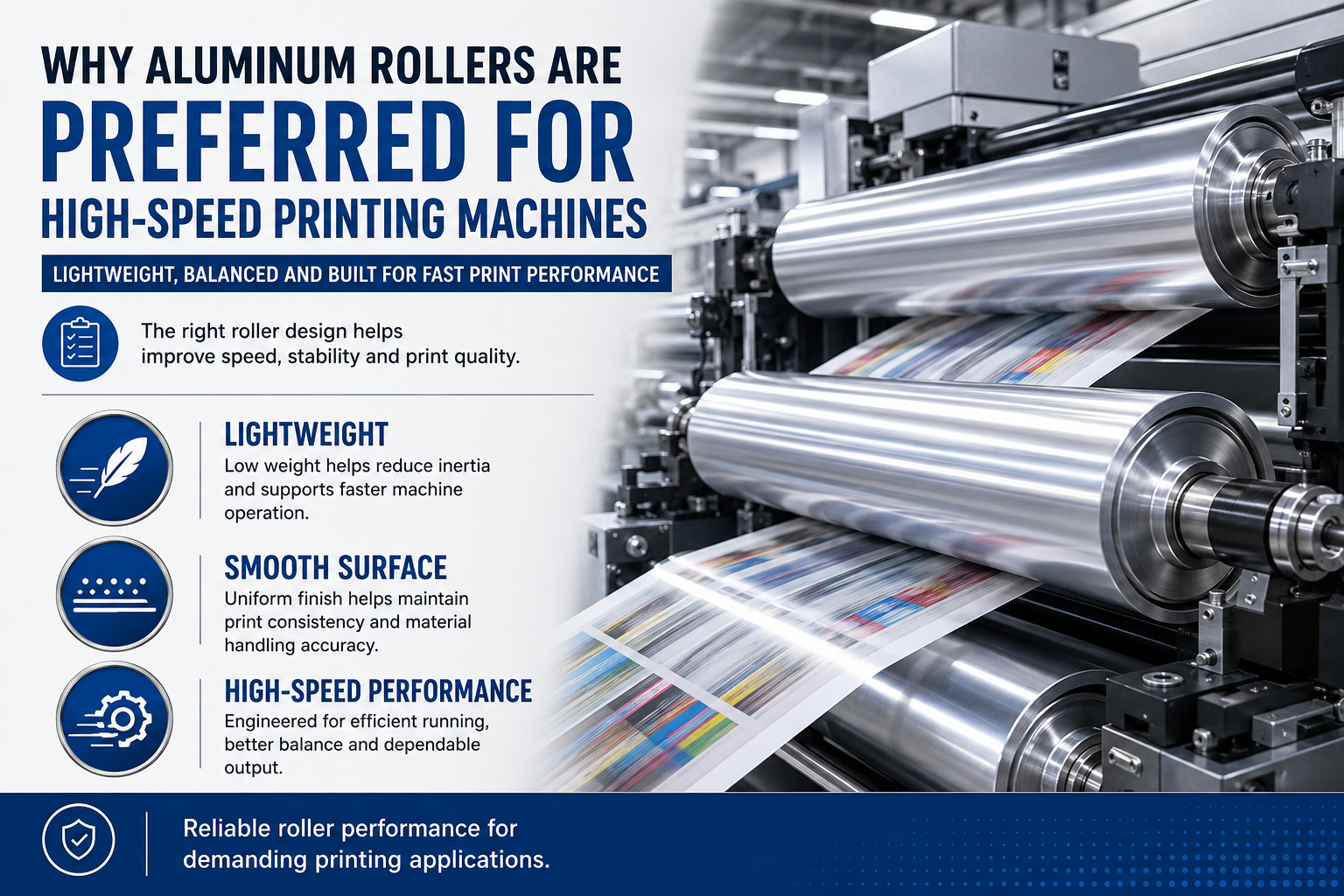
Aluminum Rollers Are Lightweight
One of the main reasons aluminum is useful for high-speed equipment is its low weight compared with many heavier metals. The Aluminum Association notes that aluminum combines low weight with strength and can weigh substantially less than steel for some applications.
A lighter roller can be useful where the machine frequently needs to accelerate, slow down or change speed.
Less rotating mass can mean less rotational inertia when other dimensions are similar.
For a printing line, this may support:
- Quicker speed changes
- Easier machine response
- Lower rotating mass
- Smooth start and stop cycles
- Reduced load on some supporting components
However, roller performance does not depend on material alone. Diameter, wall thickness, shaft design, bearings and balance also matter.
Smooth Surface Helps Material Travel Properly
The roller surface directly contacts or supports paper, film, foil or other material.
A rough or damaged roller surface may create:
- Scratches
- Marks
- Uneven movement
- Tracking problems
- Surface damage
Dhaval Engineering lists a mirror-polished surface as an available characteristic of its Aluminum Roller.
A smooth roller surface is especially useful when handling delicate printed material.
Problem:
The printed film develops marks while passing through the machine.
Possible Solution:
Check the roller for:
- Scratches
- Dirt
- Adhesive deposits
- Surface damage
- Incorrect finish
A clean and properly finished aluminum roller may help the material pass through the machine without unwanted surface contact problems.
Aluminum Does Not Rust Like Ordinary Steel
Printing machines may operate in environments where moisture, chemicals, inks or cleaning materials are present.
Aluminum is naturally corrosion resistant, although the exact resistance depends on the alloy and environment. The Aluminum Association identifies corrosion resistance as one of aluminum’s important properties.
This can make aluminum rollers useful for printing and packaging machinery where clean surfaces and regular maintenance matter.
Dhaval Engineering also highlights corrosion resistance as a benefit of its industrial aluminum rollers.
Hard Anodized Aluminum Rollers Can Improve Surface Durability
Some printing applications require more wear resistance than a basic polished aluminum surface can provide.
For such applications, a Hard Anodized Aluminum Roller may be considered.
Dhaval Engineering lists hard-anodized aluminum rollers as one of its available roller types.
Hard anodizing creates a harder oxide layer on the aluminum surface. This can be useful when the roller is exposed to regular contact and wear.
It may be selected for:
- Continuous running
- Printing machinery
- Packaging machines
- Slitting equipment
- Rewinding machines
- Web handling systems
The correct surface treatment should still be selected according to the actual material being processed.
Mirror Polished vs Hard Anodized Aluminum Roller
| Factor | Mirror Polished Roller | Hard Anodized Roller |
|---|---|---|
| Surface | Very smooth polished finish | Hard treated surface |
| Main Purpose | Smooth material contact | Improved surface wear resistance |
| Printing Use | Film, paper and web guidance | Continuous/high-use applications |
| Maintenance | Needs clean surface | Durable surface but still needs cleaning |
| Selection | Based on material contact | Based on wear and process conditions |
Aluminum Rollers Can Support High-Speed Rotation
A roller used in a fast printing line must rotate smoothly.
Because aluminum is lightweight, it can be a practical material for rollers used where low rotating mass is useful.
But speed alone should never decide the roller.
A high-speed roller should also have:
- Proper balance
- Accurate shaft alignment
- Suitable bearings
- Correct diameter
- Correct wall thickness
- Good surface finish
- Suitable shaft design
A lightweight roller with poor balance can still cause vibration.
That is why custom engineering is important.
Problem: Printing Machine Has Too Much Vibration
Vibration can become more noticeable as printing speed increases.
Possible causes may include:
- Roller imbalance
- Bent shaft
- Bearing problems
- Incorrect installation
- Damaged roller surface
- Poor alignment
- Material build-up on the roller
- Capacity options from 500 to 10,000 litres
- SS 304 and SS 316 construction
- High-speed stirrer
- Suitable mixing blade
- Mirror-finished internal areas
- Changeable blade and stirrer arrangement
- Drain valve
- Easy internal cleaning
- Half-openable protective cover
- Motor coupling arrangement
What Should You Do?
Start by checking the roller surface and mounting.
Then check:
Roller Alignment
Make sure the roller sits correctly in the machine.
Bearings
Check for unusual sound, play or wear.
Surface Build-Up
Ink, adhesive or dirt can create uneven rotating mass.
Roller Balance
High-speed applications require careful balancing.
Aluminum Rollers Can Be Customized for Different Printing Machines
Not every printing press uses the same roller size.
A roller may need a different:
- Diameter
- Length
- Shaft size
- Surface finish
- Bearing arrangement
- Roller type
- Coating or treatment
Dhaval Engineering states that its aluminum rollers can be produced according to customer requirements and that roller length can be varied in 1 mm increments.
This is useful for machine manufacturers and printing units replacing an existing roller.
Instead of selecting a general roller, the buyer can share the original drawing or machine specifications.
Live Shaft and Dead Shaft Options Provide More Flexibility
Dhaval Engineering offers both Live Shaft and Dead Shaft Aluminum Rollers.
These designs work differently.
Live Shaft Aluminum Roller
In a live-shaft design, the shaft rotates with the roller.
This design may be used where the complete rotating assembly is supported through bearings.
Dead Shaft Aluminum Roller
That depends on:
- Machine design
- Speed
- Load
- Bearing arrangement
- Available mounting space
- Original roller design
Aluminum Rollers Can Help with Web Handling
High-speed printing often uses continuous material called a web.
The web may be:
- Paper
- Plastic film
- Packaging film
- Laminate
- Foil
- Other flexible material
The web must move through the machine in the correct path.
Dhaval Engineering lists aluminum rollers for printing and tracking applications, making them relevant to this type of material movement.
Good roller condition can help support smoother web movement.
Problem: Material Moves Sideways During Printing
A web that moves left or right may create printing or slitting problems.
Before replacing the roller, check:
- Roller alignment
- Material tension
- Roller surface
- Bearing condition
- Machine frame alignment
- Web tracking settings
An aluminum roller can support smooth tracking, but it cannot correct every machine problem by itself.
This is important when troubleshooting.
Aluminum Rollers Are Useful Beyond Printing
An aluminum roller selected for printing technology may also be used in related web-processing equipment.
Dhaval Engineering lists applications including:
- Rewinding
- Unwinding
- Slitting
- Packaging
- Wrapping
- Printing
- Tracking
Its Aluminum Roller page also lists textile, printing, conveyor equipment and paper among the main application areas.
How to Choose an Aluminum Roller for a Printing Machine
Do not buy a roller based only on length and diameter.
Before ordering an Aluminum Roller for Printing Machine, collect the following information.
Machine Details
- Machine make and model
- Operating speed
- Application
- Existing roller position
Roller Dimensions
- Outer diameter
- Face length
- Total length
- Shaft diameter
- Bearing details
Material Details
- Paper
- Film
- Foil
- Laminate
- Other web material
Surface Requirement
- Mirror polished
- Hard anodized
- Other required finish
Aluminum Roller Selection Checklist
| Check | Why It Matters |
|---|---|
| Roller Diameter | Must match machine requirement |
| Roller Length | Supports correct web width |
| Shaft Type | Must suit mounting design |
| Surface Finish | Affects material contact |
| Balance | Important for smooth high-speed rotation |
| Bearing Condition | Supports smooth movement |
| Material | Affects weight and durability |
| Operating Speed | Helps define roller requirement |
| Chemical Exposure | Important for surface selection |
| Custom Drawing | Helps maintain dimensional accuracy |
Common Mistakes When Buying Aluminum Rollers
Choosing Only by Price
The cheapest roller may not match the machine properly.
Check dimensions, balance, surface finish and shaft design.
Sending Only the Roller Length
Length alone is not enough.
Provide diameter, shaft details and application.
Ignoring Surface Finish
A surface suitable for one material may not be suitable for another.
Using a Damaged Shaft
Changing only the roller surface will not solve problems caused by a bent shaft.
Ignoring Machine Speed
Tell the manufacturer if the roller will work in a high-speed machine.
Not Providing a Drawing
For custom machinery, a drawing can reduce misunderstanding and measurement errors.
How to Maintain Aluminum Rollers in Printing Machines
Clean the Surface
Remove ink, dust, adhesive and other deposits using a cleaning method compatible with the roller finish.
Check for Scratches
Small surface damage can affect delicate printing films.
Inspect Bearings
Unusual noise or resistance may indicate a bearing problem.
Check Alignment
Poor alignment can affect web movement.
Watch for Vibration
Do not ignore new vibration at higher machine speeds.
Inspect the Shaft
Check mounting points and shaft condition during planned maintenance.
Dhaval Engineering describes its aluminum rollers as easy to maintain and designed for industrial printing, paper, textile and conveyor applications.
Aluminum Roller Manufacturer in Ahmedabad for Printing Industries
Printing and packaging companies often require rollers built according to their specific machinery rather than standard dimensions.
Dhaval Engineering Works is based in Amraiwadi, Ahmedabad, Gujarat and manufactures industrial rollers for printing, textile, paper, packaging and other applications. The company states that it has operated since 1975 and supplies industrial products from Ahmedabad to customers in India and export markets.
For buyers searching for an Aluminum Roller Manufacturer in Ahmedabad, local manufacturing can make it easier to discuss:
- Drawings
- Roller dimensions
- Surface finish
- Shaft type
- Replacement requirements
- Custom machine applications
Dhaval Engineering also states that it supplies aluminum rollers across Gujarat and other Indian cities.
Why Choose Dhaval Engineering Works for Aluminum Rollers?
Dhaval Engineering manufactures customized aluminum rollers for different industrial applications.
Its Aluminum Roller range includes:
- Hard Anodized Aluminum Roller
- Dead Shaft Aluminum Roller
- Live Shaft Aluminum Roller
- Aluminum Scroll Roller
- Idler Aluminum Roller
- Mirror Polished Aluminum Roller
- Custom-length Aluminum Rollers
The rollers are used for printing, rewinding, unwinding, slitting, wrapping, packaging and tracking applications.
This allows printing-machine manufacturers and industrial users to select the roller according to the actual machine requirement instead of depending on one standard design.
Final Thoughts
Aluminum rollers are useful in high-speed printing machines because they combine low weight, useful strength, corrosion resistance and the ability to accept different surface finishes.
However, simply using aluminum does not guarantee better printing performance.
The roller must also have the correct:
Diameter + Length + Surface Finish + Shaft Design + Alignment + Balance + Bearing Arrangement
For printing units facing problems such as vibration, uneven web movement or frequent roller wear, the first step should be to understand the cause and then select a roller that matches the machine.
Dhaval Engineering Works manufactures customized Aluminum Rollers in Ahmedabad, Gujarat for printing, packaging, textile, paper, rewinding, slitting and other industrial applications.
Need a customized Aluminum Roller for your printing machine? Share your roller drawing, dimensions and application details with Dhaval Engineering Works for a suitable manufacturing solution.
FAQs
Aluminum is lightweight, durable and corrosion resistant. Its lower weight can be useful in rotating equipment where quick acceleration and smooth operation are required, although final performance also depends on roller design and balancing.
Yes. Dhaval Engineering lists printing as one of the main applications for its industrial aluminum rollers.
Dhaval Engineering lists mirror-polished aluminum rollers and also offers hard-anodized roller options.
It is an aluminum roller with an anodized surface layer designed to provide a harder and more wear-resistant surface than untreated aluminum.
Yes. Dhaval Engineering provides customized aluminum rollers and states that roller length can be adjusted according to customer specifications.
A live shaft rotates together with the roller body, while a dead shaft normally stays fixed as the roller body rotates around it. The correct option depends on the machine design.
Dhaval Engineering lists textile, printing, conveyor and paper applications, as well as rewinding, unwinding, slitting, packaging and wrapping operations.
A properly designed and balanced roller can support smoother rotation, but vibration can also come from bearings, alignment, shafts, machine frames or material build-up. The complete system should be inspected.
Provide roller diameter, face length, total length, shaft dimensions, bearing details, surface finish, machine speed, application and, if possible, a technical drawing.
Dhaval Engineering Works manufactures industrial aluminum rollers from its facility in Amraiwadi, Ahmedabad, Gujarat, with customized options for printing and other industrial machinery.