

Why Consistent Drying Is Essential for Better Yarn Quality and Weaving Performance
Sizing is an important stage in textile manufacturing because warp yarn must withstand continuous tension, friction, and abrasion during weaving. The sizing process applies a protective layer to the yarn and then removes excess moisture before the yarn moves to the next production stage.
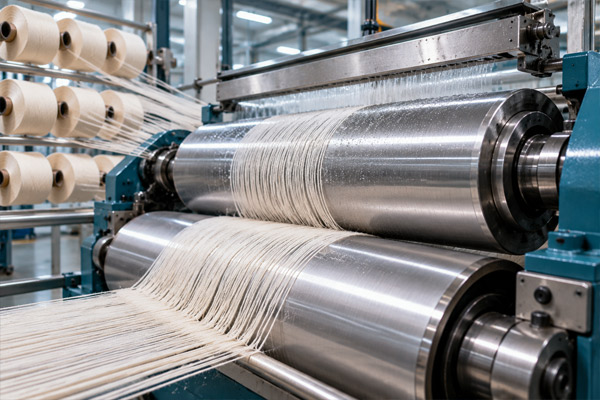
A Sizing Cylinder plays a major role in this drying process. After the warp yarn passes through the sizing solution, it moves over steam-heated cylinders. These cylinders transfer heat to the wet yarn and help achieve controlled and uniform drying. Cylinder drying is widely used in sizing machines because it provides direct heat transfer and can support high production speeds.
For textile mills, the condition, surface quality, heating uniformity, and construction of a sizing cylinder can directly affect yarn quality, production stability, and weaving efficiency.
What Is a Sizing Cylinder in Textile Machinery
A sizing cylinder is generally part of the drying section of a textile sizing machine. Once the yarn has passed through the size box and absorbed the required sizing material, it contains a considerable amount of moisture.
The wet warp sheet then passes over heated cylinders. Heat from the cylinder surface evaporates moisture while the yarn continues moving through the machine.
Modern sizing machines can use multiple drying cylinders depending on production requirements, yarn type, machine speed, and drying capacity. The number and arrangement of cylinders are selected according to the textile process and required output.
A properly designed Textile Sizing Cylinder therefore needs to provide stable rotation and consistent heat transfer across its working surface.
How Sizing Cylinders Improve Yarn Drying
Uniform drying is one of the main requirements in the sizing process.
If some portions of the warp remain too wet while others become too dry, the yarn may not perform consistently during weaving.
A good sizing cylinder supports drying in several ways.
Uniform Heat Distribution
The cylinder surface should transfer heat evenly across its width. Consistent heating helps reduce moisture variations between different sections of the warp sheet.
Controlled Moisture Removal
The objective is not simply to dry the yarn as quickly as possible. Yarn should reach the required moisture condition without excessive drying.
Over-drying can make sized yarn harsh or brittle, while insufficient drying can leave it sticky and may contribute to warp breaks during weaving.
Stable Contact With Yarn
Smooth cylinder rotation and correct surface finish help maintain stable contact between the yarn and heated surface.
This improves heat transfer and supports more predictable drying performance.
How Better Drying Improves Sizing Quality
Sizing quality depends on how well the protective size layer remains on the warp yarn.
The sizing material is intended to improve yarn strength, reduce hairiness, and protect the yarn against abrasion during weaving.
Drying has a direct influence on the final properties of the size film. Controlled drying helps maintain the required flexibility and condition of the sized yarn.
A properly functioning SS Sizing Cylinder can therefore contribute to:
- More consistent yarn moisture
- Better size-film formation
- Reduced yarn stickiness
- Improved yarn smoothness
- Lower risk of excessive brittleness
- More stable warp tension
- Improved weaving performance
- Better fabric consistency
These improvements are especially important for textile mills operating at high production speeds.
Why Surface Finish Matters in a Sizing Cylinder
The surface of a sizing cylinder remains in direct contact with the moving warp sheet.
Any roughness, irregularity, contamination, or uneven finishing can affect yarn movement.
A smooth and accurately finished Stainless Steel Sizing Cylinder helps reduce unnecessary friction and supports clean movement of yarn over the cylinder surface.
Surface quality becomes even more important when processing delicate yarns or running sizing machines at higher speeds.
Manufacturing accuracy should therefore be considered alongside material quality when selecting a sizing cylinder.
Importance of Uniform Heating
Uniform cylinder temperature is essential for consistent yarn drying.
If one area of the cylinder becomes significantly hotter than another, moisture removal can become uneven across the width of the yarn sheet.
The required drying conditions vary according to factors such as yarn material, yarn count, number of ends, sizing concentration, machine speed, cylinder dimensions, and steam conditions.
This is why textile mills should select cylinders according to their actual machine and production requirements rather than using only standard dimensions.
How Sizing Cylinders Support High Speed Textile Production
Modern textile machinery is designed for higher productivity. Some modern sizing systems can operate at speeds above 100 metres per minute depending on the machine and application.
At higher speeds, drying time becomes shorter. The cylinder must therefore provide effective heat transfer while maintaining smooth and stable rotation.
A correctly manufactured sizing cylinder can support high-speed operation by helping provide:
- Stable rotational performance
- Consistent cylinder temperature
- Reliable heat transfer
- Uniform yarn contact
- Reduced vibration
- Better drying consistency
- Continuous production
These factors can help textile mills maintain quality without unnecessarily reducing machine speed.
What Buyers Should Check Before Ordering a Sizing Cylinder
Textile mills should provide complete technical information when ordering a replacement or customized sizing cylinder.
Important details may include:
- Cylinder diameter
- Face length
- Overall length
- Shaft dimensions
- Working width
- Material requirement
- Required surface finish
- Steam pressure
- Working temperature
- Machine operating speed
- Yarn type
- Existing machine drawing
- Bearing and mounting details
Sharing these details helps a Sizing Cylinder Manufacturer design the cylinder according to actual operating requirements.
Choosing a Sizing Cylinder Manufacturer in India
A sizing cylinder is not simply a metal drum. Its dimensional accuracy, surface finish, concentricity, material quality, and heating performance can influence the entire textile sizing process.
When choosing a Sizing Cylinder Manufacturer in India, buyers should evaluate manufacturing capability, machining accuracy, customization options, quality inspection, and experience with textile machinery.
Textile companies searching for a Sizing Cylinder Manufacturer in Ahmedabad or Sizing Cylinder Manufacturer in Gujarat should also discuss machine specifications and operating conditions before finalizing the cylinder.
Custom manufacturing is particularly useful when replacing cylinders in existing machines where dimensions and mounting arrangements must match the original equipment.
Conclusion
A Sizing Cylinder plays an important role in achieving controlled yarn drying and consistent sizing quality in textile mills.
Uniform heating, accurate construction, smooth surface finishing, and stable rotation help remove moisture consistently from sized warp yarn. Proper drying can improve size-film quality, reduce yarn stickiness or brittleness, support smoother weaving, and improve production reliability.
For textile mills planning a new installation or replacing an existing cylinder, selecting a properly engineered sizing cylinder based on actual machine specifications can contribute to better yarn quality and long-term production performance.
FAQs
A sizing cylinder dries wet warp yarn after sizing by transferring heat from its heated surface to the yarn as it passes through the drying section.
Uniform heating helps maintain consistent moisture levels across the warp sheet and reduces the risk of uneven drying.
Yes. Irregular heating, poor surface finish, or unstable rotation can contribute to uneven drying and inconsistent yarn performance.
Yes. A custom sizing cylinder can be manufactured according to diameter, face length, shaft dimensions, mounting details, surface finish, and other machine requirements.
Material selection depends on operating conditions and machine design. Stainless steel is commonly considered where corrosion resistance, durability, and surface quality are important.
Provide cylinder dimensions, shaft details, working width, steam conditions, operating temperature, machine speed, yarn type, surface finish requirement, and available drawings.
Industrial roller manufacturers in Ahmedabad, Gujarat can manufacture customized sizing cylinders according to textile machinery dimensions and operating requirements.