


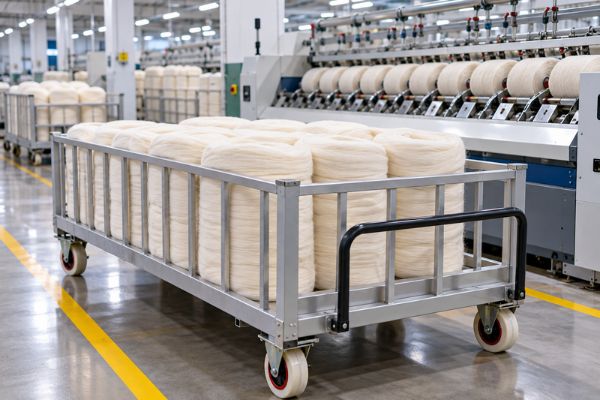
What Is a Comber Lap Trolley and How Is It Used in Textile Mills?
Moving material between machines is part of everyday work in a spinning mill. In the combing section, prepared laps need to reach the comber in good condition and at the right time. Poor handling can disturb the lap surface, while an unsuitable trolley can make movement and positioning difficult.
A comber lap trolley provides a dedicated way to carry these laps between production stages. Its size, support arrangement and wheels should match the laps, machine layout and floor conditions of the mill.
For buyers, choosing a trolley involves more than comparing frame strength or price. Lap dimensions, loaded weight, transfer height and aisle space all affect suitability. This guide explains what a comber lap trolley does, where it fits into the process and what to check before requesting a quotation.
What Is a Comber Lap Trolley?
A comber lap trolley is a wheeled handling unit used to support and transport prepared textile laps from lap preparation equipment to comber machines. Depending on its design, it may also carry empty lap tubes back to the preparation area. Textile machinery manufacturers offer both trolley-based and automated systems for this transport stage.
A lap is a wound roll of fibre sheet, often called a batt, prepared for feeding into a comber. It is different from a sliver can or a finished yarn package.
A basic trolley provides support and movement. Loading assistance, lifting features or automatic transfer are available only on designs specifically equipped for those functions.
Where Does a Comber Lap Trolley Fit in the Spinning Process?
In a combed spinning line, lap preparation equipment forms a wound lap for the comber. The trolley provides the transport link between these stages.
The typical handling sequence is:
- Prepared laps become available at the lap preparation machine.
- Laps are placed on the trolley using the approved loading method.
- The trolley moves to the required comber.
- Laps are transferred to the machine using its specified procedure.
- Empty tubes return to the preparation area where the trolley design allows.
Machine layouts and transfer systems vary. Buyers should confirm compatibility with the actual lap former and comber models instead of assuming one trolley suits every machine.
How Is a Comber Lap Trolley Used in Textile Mills?
Collecting Prepared Laps
The trolley is positioned at the designated loading area. Each lap is placed on the intended support without disturbing its wound structure.
The correct support arrangement depends on the lap dimensions, tube design and transfer method. Contact surfaces should be clean and free from sharp edges that could catch fibres.
Transporting Laps to Comber Machines
The operator moves the loaded trolley through the planned route. Suitable wheels, adequate clearance and stable load placement help make this movement manageable.
Turns, thresholds and uneven floor sections need attention. A trolley that moves easily when empty may perform differently under its full rated load.
Positioning for Lap Transfer
At the comber, the trolley must fit the available working space and the machine’s loading arrangement. Support height and access can affect how the lap is transferred.
A transport trolley does not automatically remove every lifting task. Confirm the loading and unloading method before selecting the design.
Returning Empty Lap Tubes
Some trolley arrangements provide space for empty tubes. Returning them through a planned route helps keep the preparation area supplied and reduces loose items around machines.
Confirm whether tube return is included in the proposed trolley configuration.
Why Does Correct Lap Handling Matter?
The outer layer of a lap can be disturbed by careless contact during transport. Appropriate handling helps preserve the condition of the material delivered to the comber. Trützschler identifies the sensitivity of the outer lap layer as a reason to control handling during transport.
A suitable trolley can also support a more organised workflow by providing a defined place for loaded laps and, where included, empty tubes.
Potential benefits include:
- More orderly movement between lap preparation and combing
- Less repeated carrying where the loading arrangement permits
- Better control over lap support and placement
- Easier scheduling of lap delivery
- Clearer return arrangements for empty tubes
Results depend on the trolley design and the mill’s working practices. Check performance through a trial with your actual laps and transport route rather than relying on general productivity claims.
Features to Check Before Buying a Comber Lap Trolley
| Feature | What Buyers Should Check | Why It Matters |
|---|---|---|
| Lap Support Arrangement | Suitability for lap and tube dimensions | Helps keep laps correctly seated |
| Rated Load Capacity | Permitted load and distribution | Establishes the approved carrying limit |
| Frame and Joints | Construction, rigidity and workmanship | Supports repeated loaded movement |
| Wheels and Castors | Suitability for the load and floor | Affects rolling and steering |
| Handle Position | Reach and clearance | Affects operator control |
| Overall Dimensions | Width, height and turning space | Determines route access |
| Transfer Height | Match with the machine loading method | Affects loading and unloading |
| Parking Restraint | Available brakes or restraint where needed | Helps control movement during transfer |
Ask for a drawing and written specifications before approving the order. Photos alone may not show clearances, support spacing or transfer details.
How to Select Trolley Size and Load Capacity
Start with the number of laps you need to move per trip and the maximum weight of each lap, including its tube.
For example, four laps weighing 25 kg each create a 100 kg payload. This is an illustrative calculation, not a suggested rating for Dhaval Engineering’s trolley.
Include any other carried items when calculating payload. The manufacturer should confirm the required rating, load distribution and permitted configuration.
Also share:
- Lap width and maximum diameter
- Tube dimensions and support requirements
- Maximum loaded weight per lap
- Required number of lap positions
- Loading and unloading heights
- Narrowest aisle and doorway dimensions
- Floor condition and transfer distance
A trolley with more lap positions may reduce trips, but it also needs suitable space and handling arrangements.
Manual Trolleys and Assisted Lap Transport
Manual, assisted and automated lap transport systems have different operating requirements. For example, Rieter describes a semi-automatic system with manual trolley movement and assisted loading functions, alongside a fully automated transport system. These features belong to specific equipment configurations.
| Transport Option | Typical Arrangement | Main Point to Confirm |
|---|---|---|
| Manual Trolley | Operator moves the trolley; transfer follows the mill’s procedure | Loaded movement and transfer suitability |
| Assisted or Semi-Automatic System | Some loading or transfer functions are assisted | Exact functions and machine compatibility |
| Automated Transport System | Equipment handles defined transport operations | Layout integration and supported machines |
Do not assume a standard comber lap trolley includes automatic loading or unloading. Request a clear description of the supplied functions.
Basic Comber Lap Trolley Maintenance
Routine inspection should follow the supplier’s instructions and the mill’s maintenance schedule.
Check wheels for lint build-up, damage and difficult rotation. Inspect supports for rough edges and look for loose fasteners, damaged joints or frame distortion. Test brakes where fitted.
Keep contact surfaces clean, and remove a damaged trolley from service until it has been assessed. Changes to lap size or carrying quantity should be reviewed against the approved specifications.
Comber Lap Trolley Manufacturer in Ahmedabad
Dhaval Engineering Works offers comber lap trolleys and lists custom options for size, load capacity and wheel type on its product page. The company is located in Amraiwadi, Ahmedabad, Gujarat. dhavalengineering.com
Buyers looking for a comber lap trolley manufacturer in Ahmedabad can share lap dimensions, machine details and route measurements to discuss a suitable configuration.
For textile mill enquiries from Gujarat or elsewhere in India, include the delivery location and required quantity. Confirm the final drawing, capacity, compatibility, lead time and delivery scope in the quotation.
View the Comber Lap Trolley product page to discuss your mill’s handling requirements.
FAQs
A comber lap trolley transports prepared laps between lap preparation equipment and comber machines. Some designs also carry empty lap tubes back to the preparation area.
No. A comber lap trolley supports wound laps, while a sliver can trolley handles cans containing sliver. Their supports and machine interfaces differ.
The number depends on its approved design. Confirm the lap positions, dimensions, rated payload and load distribution with the manufacturer.
Do not assume universal compatibility. Share the machine model, lap and tube dimensions, transfer height and loading method before ordering.
Only if that function is included in the supplied design. A standard manual trolley should not be assumed to provide automatic loading, unloading or lap piecing.
Dhaval Engineering’s page lists custom size, capacity and wheel options. Send your requirements and obtain written confirmation of the proposed configuration. dhavalengineering.com