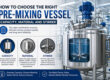


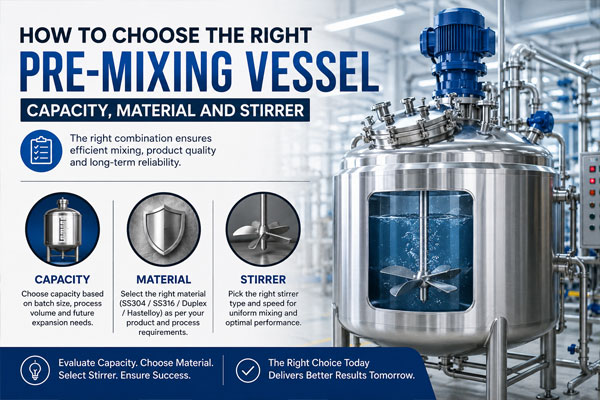
How to Choose the Right Pre-Mixing Vessel Capacity, Material and Stirrer
Choosing the right Pre-Mixing Vessel is important for smooth production and consistent product quality. A vessel that is too small may slow down production. A vessel that is too large may use extra floor space, power and cleaning time.
The vessel material and stirrer also affect performance. The wrong material may react with the product, while an unsuitable stirrer may leave lumps, foam, settled powder or unmixed areas.
Dhaval Engineering Works offers stainless steel pre-mixing vessels in SS 304 and SS 316, with listed capacities from 500 litres to 10,000 litres. Its product design includes a high-speed propeller stirrer, mixing blade, drain valve, mirror-finished internal surface and an easy-clean arrangement.
This guide explains how to select a vessel according to your batch size, product type, viscosity, mixing time and process requirements.
What Is a Pre-Mixing Vessel?
A Pre-Mixing Vessel is an industrial tank used to combine two or more ingredients before the material moves to the next production stage.
The ingredients may include:
- Water
- Liquid chemicals
- Colours
- Dyes
- Additives
- Powders
- Binders
- Oils
- Process liquids
A motor-operated stirrer moves the materials inside the vessel. This movement helps spread the ingredients through the batch and creates a more uniform mixture.
Dhaval Engineering Works describes its pre-mixing vessel as an open stainless steel vessel used for uniform chemical mixing at room temperature. The high-speed propeller stirrer can be installed vertically on the vessel top or mounted near the vessel rim.
Why Is Correct Vessel Selection Important?
The wrong vessel can cause several production problems.
A vessel that is too small may overflow or require too many batches. A very large vessel may not mix a small batch correctly because the stirrer may not remain properly covered by the liquid.
An unsuitable stirrer may create:
- Lumps
- Foam
- Air bubbles
- Powder settling
- Uneven colour
- Long mixing time
- High power use
- Product damage
- Material left near the vessel wall
Correct vessel selection can help improve:
- Batch consistency
- Mixing speed
- Product quality
- Operator safety
- Cleaning
- Material discharge
- Daily production
- Equipment life
- Future process expansion
- Understand the Product You Need to Mix
Before selecting the vessel, clearly define the product.
Ask the following questions:
- Is the product liquid, semi-liquid or thick?
- Will powder be added to a liquid?
- Are two liquids being mixed?
- Does the product form foam?
- Does the material settle quickly?
- Is heating or cooling required?
- Is the product sensitive to high speed?
- Does it contain corrosive chemicals?
- Does it need a smooth and lump-free finish?
- How long should one batch take?
A thin water-based liquid may need a different stirrer from a thick paste or heavy chemical mixture.
Do not select a vessel only by looking at its capacity. The product behaviour is equally important.
Information to Give the Manufacturer
Share the following process details:
- Product name
- Ingredient list
- Batch quantity
- Product density
- Product viscosity
- Mixing temperature
- Mixing time
- Powder quantity
- Required final quality
- Cleaning method
- Daily number of batches
Complete details help the manufacturer suggest a more suitable vessel and stirrer.
- Select the Right Vessel Capacity
Capacity is the total volume that a vessel can hold. However, the vessel should not normally be selected only according to the exact amount of product in one batch.
Space may be needed inside the vessel for:
- Safe material addition
- Liquid movement
- Powder addition
- Foam control
- Stirrer movement
- Splash prevention
- Process expansion
Example
Suppose your regular batch is 1,000 litres.
A vessel with exactly 1,000 litres of total space may not provide enough room for safe mixing. The correct total capacity should be confirmed after checking the product movement, foam level, stirrer design and required free space.
Ask the manufacturer to clearly mention:
- Total vessel capacity
- Recommended working capacity
- Minimum mixing level
- Maximum safe filling level
Dhaval Engineering Works lists pre-mixing vessel capacities from 500 litres to 10,000 litres, allowing selection for different production quantities.
Capacity Selection Table
| Regular Batch Quantity | What to Check |
| Small batch | Minimum liquid level and stirrer coverage |
| Medium batch | Mixing time, motor power and material loading |
| Large batch | Vessel strength, discharge time and floor space |
| Changing batch sizes | Stirrer performance at minimum and maximum levels |
| Future expansion | Extra capacity without making current batches difficult |
Avoid an Oversized Vessel
A bigger vessel is not always better.
An oversized vessel may create:
- Poor mixing of small batches
- Higher purchase cost
- More cleaning time
- Greater floor-space use
- Longer filling and discharge time
- Higher power requirement
- More material left inside the vessel
Select a vessel according to normal production, not only the largest batch you may produce once in the future.
- Calculate Daily Production Requirements
The vessel should support your daily production target.
Use this simple planning method:
Required daily production ÷ number of planned batches = batch quantity
For example:
- Daily production target: 5,000 litres
- Planned batches: 5
- Required batch quantity: 1,000 litres
You must also include the time required for:
- Material loading
- Mixing
- Quality checking
- Product discharge
- Vessel cleaning
- Preparation for the next batch
Example of Batch-Time Planning
| Production Stage | Estimated Time |
| Material loading | 15 minutes |
| Mixing | 30 minutes |
| Quality check | 10 minutes |
| Discharge | 15 minutes |
| Cleaning | 20 minutes |
| Total batch time | 90 minutes |
This type of calculation helps you decide whether you need:
- One large vessel
- Two medium vessels
- A faster stirrer
- A separate storage vessel
- An automatic loading system
- Choose Between SS 304 and SS 316
Pre-Mixing Vessels are commonly made from stainless steel because it provides a smooth surface, good strength and easier cleaning.
Dhaval Engineering Works offers Pre-Mixing Vessels in both SS 304 and SS 316.
However, the correct stainless steel grade depends on the actual product and cleaning chemicals.
When SS 304 May Be Suitable
SS 304 may be considered for many general mixing applications involving compatible:
- Water-based products
- Mild liquids
- Textile chemicals
- General process liquids
- Non-aggressive ingredients
It may be a practical option when the product does not create demanding corrosion conditions.
When SS 316 May Be Considered
SS 316 may be considered when the process involves:
- More demanding chemicals
- Corrosion-sensitive applications
- Strong cleaning procedures
- High-purity production needs
- Products requiring better material protection
However, SS 316 is not suitable for every chemical. Always provide the full product and cleaning-chemical details before material selection.
SS 304 vs SS 316 Comparison
| Selection Point | SS 304 | SS 316 |
| General use | Common industrial applications | More demanding applications |
| Product type | Mild and compatible materials | Selected corrosive or sensitive materials |
| Initial cost | Usually lower | Usually higher |
| Cleaning | Regular industrial cleaning | More demanding cleaning needs |
| Final decision | Based on product compatibility | Based on product compatibility |
Important Material Questions
Ask the manufacturer:
- Will all product-contact parts use the selected grade?
- What grade will be used for the stirrer shaft?
- What grade will be used for the blade?
- What grade will be used for the drain valve?
- Will the vessel receive a material test certificate?
- What internal surface finish will be provided?
- Are all welding areas properly finished?
Do not check only the vessel body. Every part that touches the product should be reviewed.
- Check Product Viscosity
Viscosity means how easily a liquid flows.
Water has low viscosity because it flows easily. A thick paste has high viscosity because it moves slowly.
Viscosity affects:
- Stirrer type
- Stirrer speed
- Motor power
- Blade size
- Shaft strength
- Mixing time
- Vessel shape
Low-Viscosity Products
Examples may include:
- Water
- Thin chemicals
- Dyes
- Light oils
- Cleaning liquids
These products may mix well with a propeller-type stirrer that creates strong liquid movement.
Medium-Viscosity Products
Examples may include:
- Coatings
- Syrups
- Liquid binders
- Thick chemical blends
- Selected emulsions
These products may need a larger blade, lower speed or higher motor torque.
High-Viscosity Products
Examples may include:
- Heavy pastes
- Thick adhesives
- Dense compounds
- High-solid mixtures
A standard high-speed propeller may not be suitable for every thick product. A paddle, anchor or another special mixer may be needed.
- Select the Right Stirrer Type
The stirrer is one of the most important parts of a Pre-Mixing Vessel.
A stirrer includes:
- Motor
- Gearbox or direct drive
- Shaft
- Coupling
- Mixing blade or impeller
- Mounting support
The right stirrer should move the complete batch. It should not mix only the material near the blade.
Dhaval Engineering Works includes a high-speed propeller stirrer and a replaceable mixing-blade arrangement in its listed Pre-Mixing Vessel design.
Propeller Stirrer
A propeller stirrer is often useful for thin and free-flowing liquids.
It may be considered for:
- Liquid-to-liquid mixing
- Water-based chemicals
- Dye solutions
- Dissolving suitable additives
- Fast circulation of low-viscosity liquids
Paddle Stirrer
A paddle stirrer moves material with broad blades.
It may be considered for:
- Medium-thickness liquids
- Slow and controlled mixing
- Products sensitive to very high speed
- Blends requiring gentle movement
Anchor Stirrer
An anchor stirrer moves close to the vessel wall.
It may be considered for:
- Thick products
- Slow-moving materials
- Products that remain near the wall
- Processes requiring low-speed and high-torque mixing
High-Speed Disperser
A high-speed disperser may be considered when powders or pigments need to be broken and spread through a liquid.
It may be useful for:
- Paints
- Coatings
- Pigments
- Powder dispersion
- Selected chemical products
The final choice should be made after checking the full process. One stirrer cannot provide the best result for every product.
- Select the Correct Stirrer Speed
Higher speed does not always mean better mixing.
Excessive speed may cause:
- Foam
- Air entering the product
- Splashing
- Product heating
- Blade wear
- Motor overload
- Product damage
- Unstable mixing
Low speed may cause:
- Powder settling
- Long mixing time
- Unmixed areas
- Poor colour distribution
- Material build-up
Ask for Variable Speed
A variable-speed drive can help the operator adjust the stirrer for different production stages.
For example:
- Start at a low speed.
- Add the liquid.
- Slowly add powder.
- Increase speed for mixing.
- Reduce speed before discharge.
This can provide better control when the vessel handles several products.
- Check Motor Power and Torque
Motor power should match the:
- Product viscosity
- Batch quantity
- Stirrer diameter
- Mixing speed
- Number of blades
- Shaft length
- Required mixing time
A motor that is too small may:
- Overheat
- Stop during mixing
- Mix slowly
- Fail to move thick material
- Require frequent maintenance
A motor that is too large may increase cost and power use without improving the process.
Ask the manufacturer to confirm the motor rating after reviewing your actual product.
Motor Details to Check
- Motor power
- Motor speed
- Gearbox ratio
- Output speed
- Required electrical supply
- Variable-speed option
- Overload protection
- Motor mounting
- Maintenance access
Why Choose Dhaval Engineering Works?
Dhaval Engineering Works manufactures and supplies industrial equipment from Ahmedabad. According to its company profile, it has operated since 1975 and provides customised equipment for client-specific requirements.
Its Pre-Mixing Vessel range includes:
- Capacity options from 500 to 10,000 litres
- SS 304 and SS 316 construction
- High-speed stirrer
- Suitable mixing blade
- Mirror-finished internal areas
- Changeable blade and stirrer arrangement
- Drain valve
- Easy internal cleaning
- Half-openable protective cover
- Motor coupling arrangement
Customers should share complete product and process information to receive a suitable technical recommendation.
SS Sizing Roll Application Table
| Application | Use of SS Sizing Roll |
|---|---|
| Yarn Sizing Machine | Supports yarn movement and the sizing process |
| Fabric Processing Unit | Helps ensure smooth fabric movement |
| Textile Finishing Machine | Supports finishing and surface handling |
| Weaving Preparation | Helps reduce yarn breakage before weaving |
| Industrial Textile Machinery | Supports continuous roller-based operation |
| Processing Line | Helps materials move smoothly and evenly |
Questions to Ask a Pre-Mixing Vessel Manufacturer
Ask these questions before approving the vessel:
- Which capacity is suitable for our batch?
- What will be the recommended working volume?
- Should we select SS 304 or SS 316?
- Are all product-contact parts made from the same grade?
- Which stirrer is suitable for our viscosity?
- What motor power is required?
- Is variable speed available?
- How long may one batch take?
- Will the powder settle at the bottom?
- How will the vessel be cleaned?
- Can the blade be removed?
Conclusion
Choosing the right Pre-Mixing Vessel is not only about selecting a tank size.
The vessel capacity must match your actual batch quantity. The material must be compatible with the product and cleaning chemicals. The stirrer must suit the viscosity, powder content and required final quality.
You should also review motor power, speed, blade position, internal finish, drain system, cleaning access, temperature control and safety.
Do not select a vessel only by price or total capacity. Share complete process details with the manufacturer and request a clear technical drawing. A properly selected vessel can reduce mixing time, improve consistency and support smoother production.
FAQs
A Pre-Mixing Vessel is a stainless steel tank used to mix liquids, powders, chemicals and additives before the next production stage.
Select capacity according to your normal batch quantity, required free space, product movement, foam level and future production needs.
The choice depends on the product, chemical strength, cleaning method and working conditions. Material compatibility should be confirmed before manufacturing.
A propeller may suit thin liquids, while paddles or anchor stirrers may be considered for thicker materials. Final selection depends on viscosity and process needs.
No. High speed may create foam, air bubbles or product damage in some materials. Stirrer speed should match the product.
Working capacity leaves free space for safe liquid movement, ingredient addition, foam and splash control.
Yes, when the vessel, stirrer, motor and powder-addition method are properly selected.
Yes. A jacketed design may be used when the product needs controlled heating or cooling.