
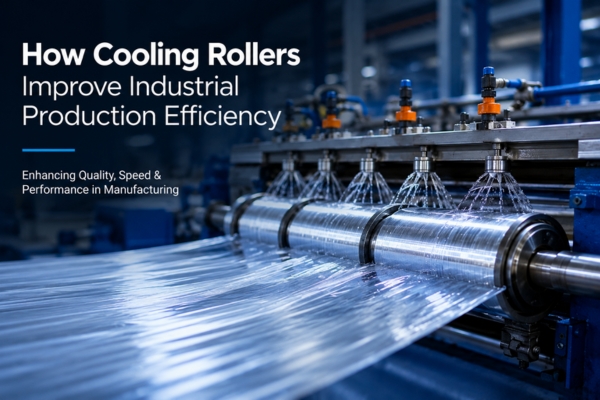
In modern industries, machines work continuously to produce large quantities of products every day. During production, many materials become very hot because of friction, pressure, or heating processes. Excess heat can damage product quality, slow down production, and reduce machine performance. This is where cooling rollers become very important.
Cooling rollers help control product temperature during manufacturing. They remove heat from materials and keep the production process smooth and stable. Industries like plastic processing, rubber manufacturing, textile, packaging, steel, paper, and printing widely use cooling rollers for better production quality and efficiency.
Using the right cooling roller helps industries improve machine speed, reduce defects, save energy, and increase production output. This guide explains how cooling rollers improve industrial production efficiency and why they are important for modern manufacturing systems.
What is a Cooling Roller?
A cooling roller is an industrial roller designed to reduce heat from materials during production. It helps cool hot surfaces quickly and evenly. Cooling rollers are usually made from strong metals like steel or stainless steel and may contain internal cooling systems using water or other cooling liquids.
Main Functions of Cooling Rollers
Reduce Product Temperature
Improve Surface Finish
Prevent Product Damage
Maintain Production Speed
Improve Machine Efficiency
Why Cooling is Important in Industrial Production
Heat is generated in many industrial processes. If heat is not controlled properly, products may become damaged or lose quality. Proper cooling helps industries avoid these problems.
Problems Caused by Excess Heat
Product Deformation
Uneven Surface Finish
Material Sticking
Slow Production Speed
Machine Overheating
Increased Product Rejection
Poor Dimensional Accuracy
How Cooling Rollers Work
Cooling rollers absorb heat from hot materials while they move through the production line. Inside the roller, cooling water or liquid circulates continuously to maintain a lower temperature. As hot material touches the roller surface, heat transfers into the roller and gets removed by the cooling system. This process keeps the material temperature controlled and stable.
Industries Using Cooling Rollers
Cooling rollers are used across many industrial sectors where heat control is essential for quality and productivity.
Plastic Industry
Rubber Industry
Packaging Industry
Textile Industry
Steel & Paper Industry
Printing & Lamination & Extrusion
How Cooling Rollers Improve Production Efficiency
Cooling rollers help improve production in several important ways. Here are the seven key ways they make a difference.
1. Faster Cooling Process
Cooling rollers quickly reduce material temperature during production, resulting in faster production cycles, increased machine speed, higher production output, and reduced waiting time. In plastic extrusion lines, cooling rollers help cool plastic sheets quickly so production continues smoothly.
2. Better Product Quality
Uneven cooling can damage product quality. Cooling rollers provide uniform cooling across the material surface, resulting in a smooth surface finish, better product appearance, accurate product dimensions, and reduced defects.
3. Reduced Production Downtime
Overheating may stop machines frequently. Cooling rollers help maintain stable temperatures and reduce machine stress — resulting in fewer machine stoppages, reduced maintenance issues, continuous production, and improved operational efficiency.
4. Improved Machine Performance
Machines work better when heat is controlled properly. The result is smooth machine operation, lower vibration, reduced stress on components, and better overall equipment life.
5. Increased Production Speed
Cooling rollers allow machines to operate at higher speeds safely, leading to higher daily production, better productivity, and faster order completion.
6. Reduced Product Rejection
Poor cooling often creates defective products. Cooling rollers help maintain consistent product quality and reduce common problems like surface marks, cracks, warping, material distortion, and uneven thickness.
7. Better Surface Finish
Cooling rollers improve the final product appearance. Industries that benefit most include plastic sheet manufacturing, lamination, packaging, and textile coating applications.
Types of Cooling Rollers
Different industries use different cooling roller designs based on their specific production requirements.
Water Cooling Rollers
Use internal water circulation for cooling. Efficient temperature control, stable performance, and widely used in extrusion plants.
Air Cooling Rollers
Use airflow for temperature reduction. Simple design, lower maintenance, and suitable for light cooling applications.
Chrome Plated Cooling Rollers
Chrome-coated surface for durability. Better surface finish, corrosion resistance, and long service life.
Stainless Steel Cooling Rollers
Used where hygiene and corrosion resistance are essential. Common in food processing, pharmaceutical, and packaging industries.
Important Features of High Quality Cooling Rollers
Choosing the right cooling roller is important for industrial efficiency. Look for these key features when selecting a cooling roller for your production line.
High Strength Material
Smooth Surface Finish
Proper Balancing
Corrosion Resistance
Efficient Cooling System
Precision Engineering
Durable Construction
Common Cooling Roller Problems
Poor maintenance or low-quality rollers can create production problems. Understanding these issues helps industries take the right corrective steps.
Uneven Cooling
Causes: Blocked cooling channels, improper water flow, or roller damage.
Solution: Regular cleaning and inspection.
Roller Surface Damage
Causes: Continuous friction, poor maintenance, or material buildup.
Solution: Surface polishing and proper maintenance.
Excess Vibration
Causes: Improper balancing or worn bearings.
Solution: Regular balancing and bearing replacement.
Tips to Improve Cooling Roller Performance
Clean rollers regularly
Check cooling water flow
Monitor roller temperature
Inspect bearings regularly
Avoid overloading
Replace damaged parts quickly
Perform regular maintenance checks
How to Choose the Right Cooling Roller
Selecting the correct cooling roller improves production efficiency and product quality. Consider these important factors:
Product Type
Different materials need different cooling systems.
Production Speed
High-speed production requires efficient cooling rollers.
Surface Finish Requirement
Choose precision rollers for smooth product finish.
Working Environment
Check temperature, moisture, and operating conditions.
Roller Material
Select strong and corrosion-resistant materials.
Benefits of Using High Quality Cooling Rollers
Improved Production Efficiency
Better Product Quality
Faster Manufacturing Process
Reduced Maintenance Costs
Longer Machine Life
Better Temperature Control
Reduced Production Defects
Increased Productivity
Why Choose Dhaval Engineering?
Dhaval Engineering provides reliable industrial cooling roller solutions designed for modern manufacturing industries.
High Quality Manufacturing
Industry-grade materials and strict quality standards in every cooling roller we manufacture.
Precision Engineered Rollers
Engineered with precision for smooth, balanced, and efficient performance across all industrial applications.
Durable Industrial Products
Built to last longer and withstand demanding industrial environments with minimal maintenance.
Custom Roller Solutions
Tailor-made cooling roller solutions designed to meet specific industrial requirements and production goals.
Reliable Industrial Support
Dedicated customer support and after-sales service to ensure smooth and uninterrupted production operations.
Advanced Manufacturing Technology
Backed by advanced manufacturing technology for superior roller quality, accuracy, and long-term performance.
Conclusion
Cooling rollers play an important role in improving industrial production efficiency. They help control temperature, improve product quality, reduce machine downtime, and increase production speed.
Industries that use high quality cooling rollers can achieve better productivity, lower maintenance costs, and smoother manufacturing operations. Choosing the right cooling roller is an important step for improving industrial performance and long-term production success.
Frequently Asked Questions
What is the main purpose of a cooling roller?
A cooling roller helps reduce heat from materials during industrial production, keeping the process smooth, stable, and efficient.
Which industries use cooling rollers?
Industries like plastic, rubber, packaging, textile, steel, and paper widely use cooling rollers to control heat and maintain product quality.
How do cooling rollers improve product quality?
They provide uniform cooling across the material surface, which reduces defects and improves the final surface finish and dimensional accuracy.
Why is proper cooling important in manufacturing?
Proper cooling prevents overheating, product damage, poor surface finish, and unexpected machine downtime — all of which directly impact production efficiency.
How can cooling roller life be increased?
Regular maintenance, proper cleaning, monitoring of cooling water flow, timely replacement of worn bearings, and correct operation help increase cooling roller life significantly.