

SS Jacketed Cooling Vessel for Textile Processing Industries in Gujarat
Temperature control is an important part of many textile processing operations. During chemical preparation, mixing and related production steps, even a small change in temperature can affect process consistency. An SS Jacketed Cooling Vessel gives textile manufacturers a controlled way to cool, heat, mix and hold process liquids inside one vessel.
For textile processing plants in Gujarat, a jacketed vessel can be useful where chemicals, process liquids or other materials need controlled temperature before they move to the next stage. Dhaval Engineering Works manufactures SS Jacketed Cooling and Heating Vessels in Ahmedabad and states that its vessels are available in SS 304 and SS 316, with customizable capacities from 500 litres to 10,000 litres.
The right vessel can help solve common production problems such as uneven temperature, slow cooling, poor mixing and repeated manual handling.
Why Temperature Control Matters in Textile Processing
Textile processing often involves liquids, chemicals and mixtures that need to stay within a suitable temperature range. If the liquid becomes too hot or too cold, the process may become difficult to control.
Common problems can include:
- Uneven chemical preparation
- Slow batch cooling
- Different results from one batch to another
- Extra production time
- Manual temperature adjustment
- Higher chances of material waste
- Difficulty maintaining the next process stage
An SS Jacketed Cooling Vessel helps by allowing a cooling or heating medium to move around the outside of the main product chamber.
Dhaval Engineering’s jacketed vessel design can work with chilled water, hot water, steam or thermic fluid depending on the process requirement.
How Does an SS Jacketed Cooling Vessel Work?
The basic design is simple.
A jacketed vessel has:
Inner Vessel:
This part holds the process liquid or material.
Outer Jacket:
This surrounds part or all of the inner vessel.
Cooling or Heating Medium:
Chilled water, hot water, steam or another suitable thermal fluid moves through the jacket.Outer Jacket:
This surrounds part or all of the inner vessel.
Outlet and Inlet Connections:
These allow the thermal medium to enter and leave the jacket.
Agitator, if required:
A mixer can help move the liquid inside the vessel and support more even temperature distribution.
Simple Process
Hot Process Liquid → Vessel → Cooling Medium Through Jacket → Controlled Cooling → Material Ready for Next Process
Where Can Jacketed Cooling Vessels Help in a Textile Plant?
A Cooling Vessel for Textile Industry can support different process areas depending on the plant setup.
Possible applications include:
- Chemical preparation
- Process-liquid mixing
- Solution preparation
- Controlled cooling after heating
- Batch holding
- Additive preparation
- Intermediate process storage
- Mixing before transfer
- Temperature-controlled liquid handling
The exact vessel design should always depend on the liquid, required temperature, batch size and factory process.
Dhaval Engineering Works lists textile as one of the industries it serves and describes its wider product range as being used in textile-industry applications.
Problem: Cooling Takes Too Long
One common production issue is a batch that takes too long to cool.
Natural cooling can depend on:
- Room temperature
- Batch size
- Vessel shape
- Process-liquid temperature
- Air movement
- Surrounding conditions
This can slow the next production step.
Solution: Use a Cooling Jacket
With an SS jacketed vessel, chilled or cooling water can circulate through the jacket.
This gives the process team a more direct way to remove heat from the batch.
For a textile processing plant, faster and controlled cooling can help:
- Reduce waiting time
- Improve batch planning
- Make production flow easier
- Reduce manual handling
- Prepare material for the next process in a more controlled way
Problem: Temperature Is Different in Different Parts of the Vessel
A large batch can sometimes have temperature differences between the top, middle and bottom areas.
This may happen when the liquid is not moving properly.
Solution: Add an Agitator
An agitator helps move the liquid inside the vessel.
This can help distribute temperature more evenly and keep the mixture moving during cooling or heating.
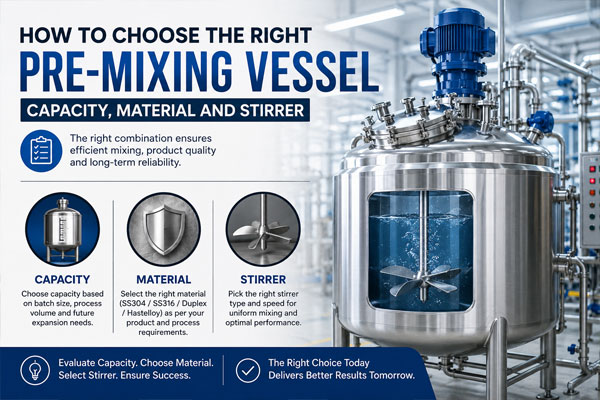
Dhaval Engineering offers jacketed vessels with optional top-mounted stirrers or agitators for applications that require mixing.
When selecting the agitator, the buyer should discuss:
- Liquid type
- Liquid thickness
- Batch volume
- Mixing speed
- Required cooling time
- Process temperature
The agitator should be selected for the actual process instead of using one standard mixer for every application.
SS 304 or SS 316: Which Material Should You Choose?
Dhaval Engineering manufactures its jacketed cooling and heating vessels in SS 304 and SS 316.
Both are stainless steel grades, but the correct choice depends on the process material.
SS 304
SS 304 may be suitable for many general industrial applications where the process medium is compatible with this material.
SS 316
SS 316 can be considered where stronger corrosion resistance is required because of the chemical environment or process conditions.
Before finalizing the material, textile processors should provide the vessel manufacturer with:
- Chemical name
- Concentration
- Operating temperature
- Batch duration
- Cleaning method
- Required surface finish
This helps the manufacturer recommend a suitable stainless steel grade for the application.
Technical Options Available for SS Jacketed Vessels
| Feature | Available Option |
|---|---|
| Capacity | 500 L to 10,000 L, customizable |
| Material | SS 304 / SS 316 |
| Inner Finish | Mirror finish available |
| Jacket Type | Conventional / Dimple / Limpet Coil |
| Cooling Medium | Chilled Water |
| Heating Medium | Steam / Hot Water / Thermic Fluid |
| Mixing | Agitator / Stirrer option |
| Design | Customized as per application |
Different Jacket Types and Why They Matter
Not every jacketed vessel needs the same jacket design.
Dhaval Engineering offers conventional jacket, dimple jacket and limpet coil options.
Conventional Jacket
A conventional jacket surrounds the vessel and allows the heating or cooling medium to flow around the inner chamber.
It is a simple option for many process applications.
Dimple Jacket
A dimple jacket uses a patterned outer surface to create channels for the thermal medium.
It can be useful when a compact jacket design is required.
Limpet Coil Jacket
A limpet or half-pipe coil is fixed around the vessel.
The thermal medium flows through this coil.
The right choice depends on:
- Required temperature change
- Operating pressure
- Vessel size
- Utility available
- Heating or cooling rate
- Process requirement
How to Select the Right Capacity
Buying one that is much larger than needed can increase space and utility requirements.
Start with these questions:
- What is the normal batch size?
- What is the maximum batch size?
- How many batches run each day?
- How much free space is required inside the vessel?
- Will an agitator be used?
- Is future production expansion planned?
Dhaval Engineering offers vessels from 500 litres to 10,000 litres with customization, which allows buyers to select a capacity around their process requirement.
For example, a plant should not automatically choose a 5,000-litre vessel just because a larger vessel appears more useful. The required working volume should be calculated based on the actual process.
Checklist Before Buying an SS Jacketed Cooling Vessel
Before asking for a quotation, prepare the following information.
Process Details
- Material or chemical handled
- Batch quantity
- Operating temperature
- Starting temperature
- Final required temperature
Vessel Details
- Required capacity
- SS 304 or SS 316 preference
- Jacket type
- Surface finish
- Required outlet size
Cooling Details
- Cooling medium available
- Chilled water temperature
- Cooling time target
- Utility connection size
Mixing Details
- Is an agitator required?
- Material thickness
- Required mixing speed
- Motor requirement
Installation Details
- Factory location
- Available floor space
- Vessel height restriction
- Platform requirement
- Pipeline connection requirement
Common Mistakes to Avoid
Buying Only Based on Capacity
Capacity is important, but temperature, mixing and material compatibility are also important.
Selecting the Wrong Stainless Steel Grade
The vessel material should match the chemical or process liquid.
Ignoring Cooling Utility
A cooling vessel cannot perform well if the available chilled-water system cannot support the required duty.
Forgetting About Cleaning
The vessel should be easy to clean according to the process requirement.
Ignoring Future Expansion
A plant that expects higher production should discuss future batch requirements before finalizing vessel size.
Not Planning the Agitator
Cooling and mixing often work together. If the material needs continuous movement, the agitator should be included during the design stage.
Why Stainless Steel Is Useful for Textile Process Vessels
Stainless steel is widely selected for industrial process vessels because it offers a clean surface, good strength and useful corrosion resistance when the correct grade is selected for the process.
For textile processors, an SS vessel can also make maintenance and cleaning easier compared with many rough or reactive surfaces.
Dhaval Engineering manufactures its jacketed vessels in SS 304 and SS 316 and states that an internal mirror finish is available.
A smooth internal surface can also help reduce places where process material can remain after a batch
Why Choose Dhaval Engineering Works?
Dhaval Engineering Works manufactures industrial vessels, cylinders and rollers from Ahmedabad and has served industrial customers since 1975 according to its website.
For SS jacketed vessels, the company offers:
- SS 304 and SS 316 construction
- 500 L to 10,000 L customizable capacity
- Conventional jackets
- Dimple jackets
- Limpet coil jackets
- Steam compatibility
- Hot water compatibility
- Thermic-fluid compatibility
- Chilled-water compatibility
- Agitator and stirrer options
- Customized vessel design
Final Thoughts
An SS Jacketed Cooling Vessel for textile processing industries in Gujarat can help solve many practical production problems when temperature control and liquid mixing are important.
The main goal is not simply to buy a stainless steel tank. The vessel should be designed around the batch size, process liquid, cooling requirement, mixing need and available utilities.
Textile manufacturers should discuss all these details before finalizing the vessel.
A properly selected jacketed cooling vessel can help make the process easier to control, reduce unnecessary waiting and support more consistent batch handling.
For customized SS Jacketed Cooling and Heating Vessels in Ahmedabad, Gujarat, Dhaval Engineering Works offers SS 304/316 vessels with multiple jacket designs and cooling/heating media options
FAQs
An SS Jacketed Cooling Vessel is a stainless steel process vessel with an outer jacket through which a cooling medium can circulate to control the temperature of the material inside.
Yes. It can be used where textile-process liquids, chemical preparations or other batches need controlled cooling, heating, holding or mixing.
Dhaval Engineering offers SS 304 and SS 316 options for its jacketed cooling and heating vessels.
Dhaval Engineering lists customizable capacities from 500 litres to 10,000 litres.
Chilled water can be circulated through the vessel jacket for cooling. The same vessel range can also support hot water, steam and thermic fluid for heating applications.
Yes. Dhaval Engineering states that top-mounted heavy-duty stirrers and agitators can be provided for applications requiring mixing.
Conventional, dimple and limpet coil jacket designs are listed as available options.
Consider batch capacity, liquid type, operating temperature, required cooling time, stainless steel grade, jacket type, mixing requirement and available factory utilities.
Yes. Dhaval Engineering states that vessel capacity and design can be customized according to project requirements.
Dhaval Engineering Works is located in Amraiwadi, Ahmedabad, Gujarat, and serves textile and other industrial sectors.